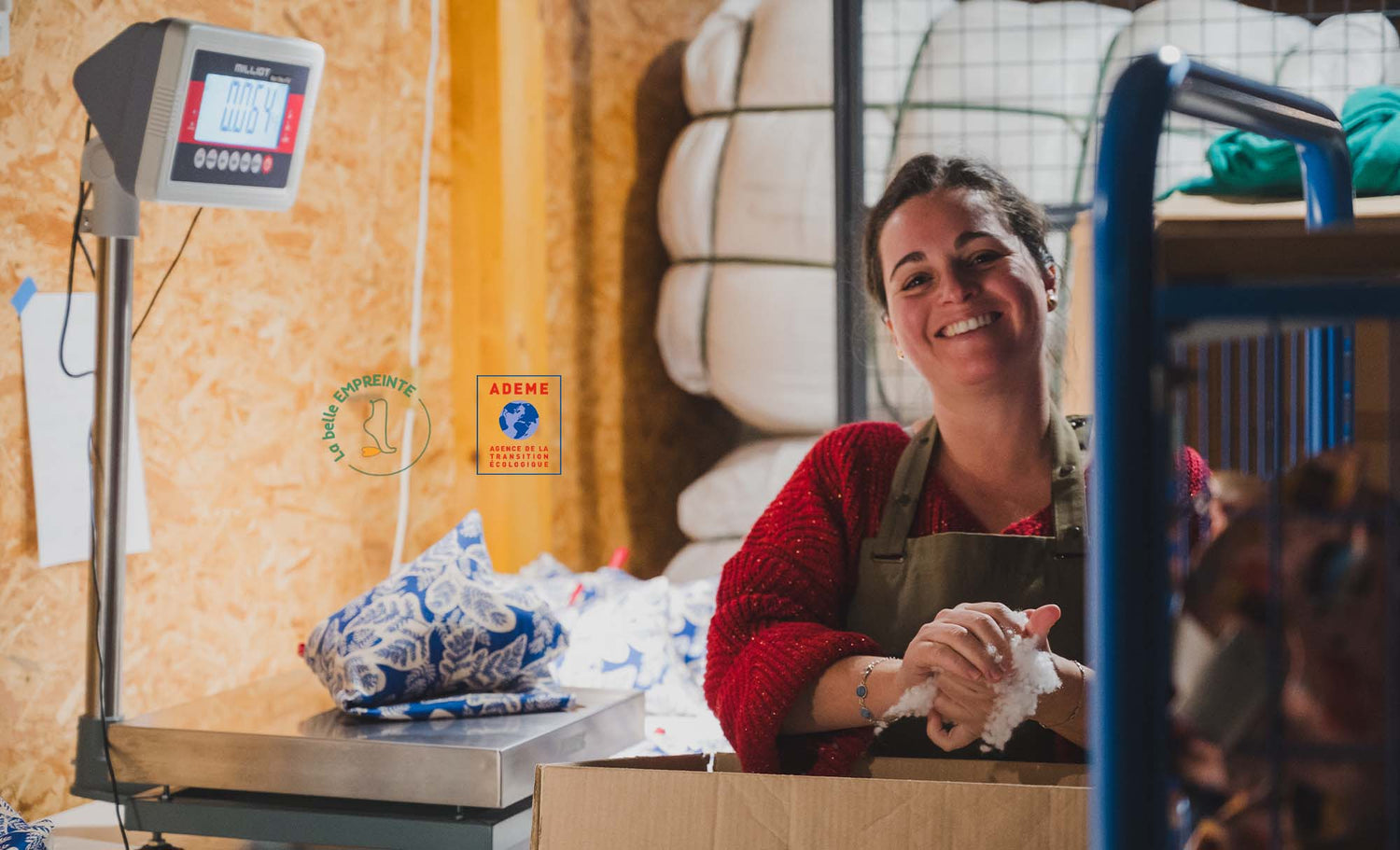
At the beginning of 2024, we made an important decision: to embark on training in environmental footprint, supported by ADEME, the Agency for Ecological Transition .
This training will help you understand the challenges as a manufacturer and e-commerce business and use a powerful calculation tool that prevents you from navigating blindly. Because, let's be honest, in this field, it's easy to fall into the traps of common misconceptions and other cognitive biases. And you'll understand why it's so exciting and why the future is being shaped now! Let me tell you about it.

A BEAUTIFUL IMPRINT
When I started the training with labelleempreinte , what struck me first was that the topic wasn't carbon footprint. Or at least not only that. But rather the environmental footprint. And it's true that, when you really think about it, carbon is only one facet of the problem. Perhaps because it's the number one issue in the face of global warming and is widely covered by the media, I myself had gotten into the habit of always talking about "carbon footprint."
However, the footprint of an object, particularly in the textile sector, goes far beyond carbon. It also includes water and air pollution. It also has a social dimension, through the treatment of workers in the factories.
When we zoom out, we realize that environmental footprint is a much more accurate and comprehensive term for defining a product's impact on the environment. And changing the words also means changing our perspective. For me, this is a fundamental shift.
THE LIFE CYCLE
Another major realization was the concept of the product lifecycle. What's that? It's simply the fact that the longer a product lasts, the smaller its carbon footprint becomes. That's why a high-quality product, carefully crafted from durable materials, will have a much smaller environmental footprint than the same item made cheaply and used for a very limited time.
This is why you often hear "made in France" brands emphasize product quality. If it's high quality, it will last longer. If it lasts longer, its environmental footprint will be smaller (note that you'll also save money, buying once instead of multiple times!).
Ultimately, an environmental footprint is like wine. It improves with age. 😂
A CALCULATION TOOL
This is the most important element of this training! Because let's be honest, without figures, it is totally impossible to know what we are doing and, without proof, all we can say remains good intentions.
The strength of the environmental footprint calculator lies in its ability to integrate detailed data to establish a precise environmental footprint. Most importantly, the tool allows you to compare the footprint with that of a similar standard product. And this comparison capability makes all the difference! Because numbers are all well and good, but not always very meaningful. If I tell you that our ELLIPSE travel pillow has a carbon footprint of 2.6 kg, I imagine that means absolutely nothing to you. However, if I tell you that our ELLIPSE pillow has a footprint reduced by 70% compared to a standard equivalent product, you have to admit that's much more impactful! And we can also see that our product already meets the objectives of the 2030 Agenda (the UN's program for ecological transition). 💪

The calculation tool is truly the death knell for "bullshit" and other nonsense. With it, it's impossible to lie to oneself or soothe one's conscience with intuitions or imagined explanations. All the data defining the product is integrated into the tool with a high degree of detail. For example, for each piece of fabric used, in addition to its dimensions, weight, and composition, the cotton's growing location, the spinning, weaving, dyeing (if applicable), and finishing locations must be specified. And this precision is fundamental.
STOP MOVING FORWARD IN THE DARK
Since the creation of Cosy club 6 years ago, Muriel and I have intuitively made many decisions in favor of environmental protection.
Today, thanks to this calculation tool, we can finally navigate with a real compass. We can demonstrate and quantify our impact. We can also realize that we have made good decisions, such as using upholstery made from recycled plastic . Even though this upholstery is three times more expensive than the same upholstery made from virgin plastic, we now know, thanks to this tool, that its environmental footprint is much lower!
And that's not all; the calculation tool also has a powerful feature: it directly indicates the priority levers for further reducing the footprint. For Petits Cadors, for example, our priority will be in fabric sourcing. This is where we can make a significant difference.
And it's important to know this to avoid getting lost in actions that might seem important but aren't at all! It's also a way to avoid empty promises like "We're eco-responsible, we use paper packaging" when that can sometimes represent only 0.01% of the product's overall footprint!
ECO-DESIGN
Finally, the calculation tool is also an eco-design tool. Why? Because when we are in a research and development phase, we can directly run simulations and compare the impact based on our possible choices. For example, directly compare two fabrics from two different suppliers. Compare two fabrics with different compositions, or even a fabric containing recycled cotton and another made from organic cotton.
And it is precisely because we can now make comparisons on a real numerical basis that we will be able to continue to work with confidence, on solid foundations and continue to improve on this point which is so important to us.
For you, the customer, this is the assurance of buying products with a low footprint, without greenwashing, simply by consulting our product sheets which contain an information insert on the environmental footprint of the product (this is already the case for ELLIPSE , TEODOR and DUOH! ).
Personally, I'm very happy to have completed this training and I want to thank the entire Labelleempreinte team. Throughout the course, I felt that we are only at the beginning of a major shift and that the future is being shaped here, with theoretical knowledge on one hand and precise calculation tools on the other. It is in this way, and only in this way, that we can truly implement a genuine ecological transition.
We are very proud to be part of this dynamic!