
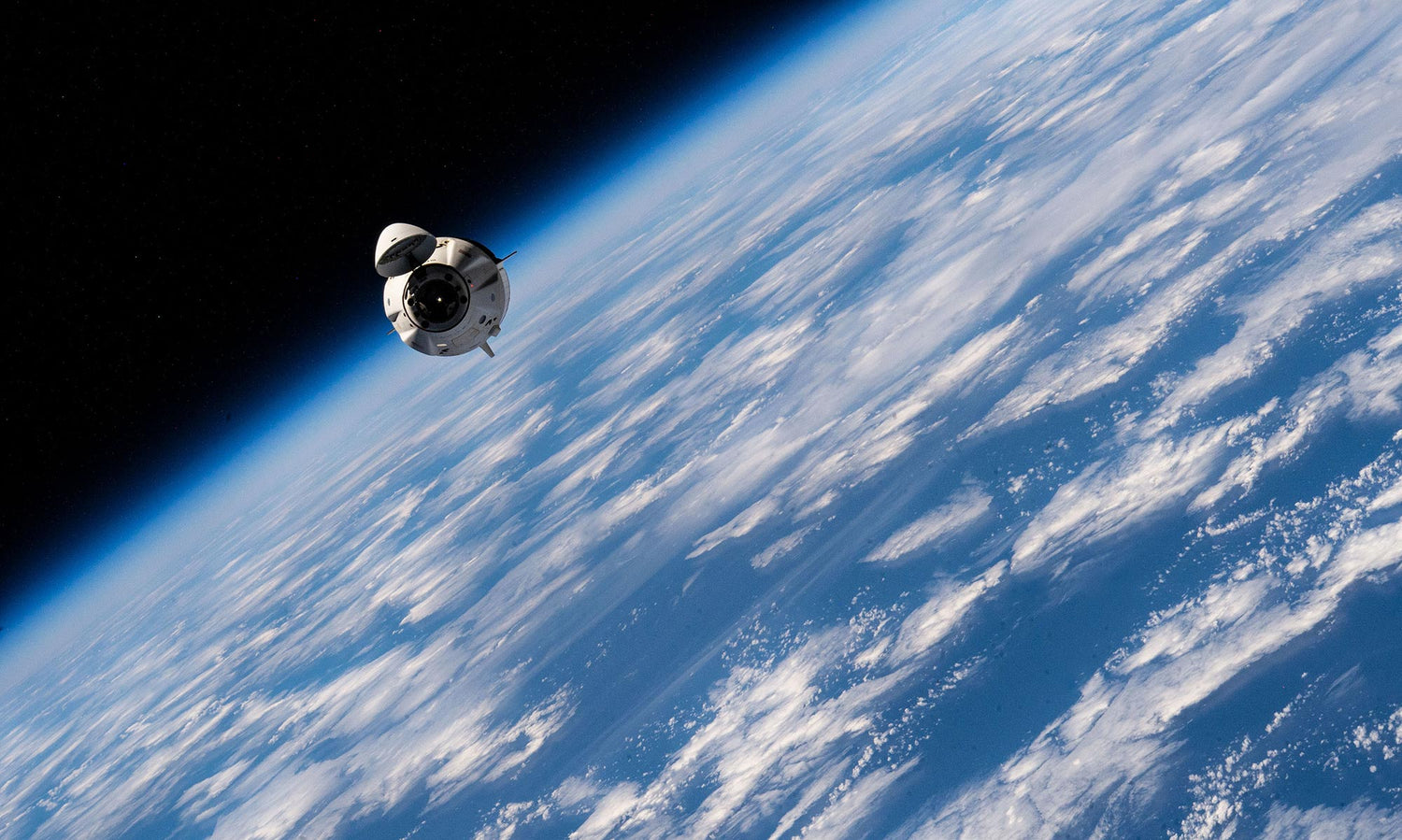
As I write these lines, I confess that I myself find it a little hard to believe. And yet, after several months of research and development on an incredible project, it is finally possible to tell you about a cushion that we would never have imagined designing and manufacturing, even in our wildest dreams: a cervical cushion commissioned by the ESA ( European Space Agency ) for the next space mission of the French astronaut most involved in raising awareness of environmental issues: Thomas Pesquet .
Let me tell you about this incredible adventure that started almost 2 years ago.
AN UNLIKELY CALL
On Tuesday, October 24, 2023, around 4 p.m., I received a call from Sarah Hampton who introduced herself as a Space Life Support Systems Engineer at ESA. Naturally, my first reaction was to tell her she was probably mistaken, but she immediately corrected me, explaining that she had identified our company as a potential partner for a very specific project : the development of a head cushion to be used by Thomas Pesquet during his next mission in space.
To clarify the request, and perhaps sensing my slight surprise, she explained that this project was part of an effort to improve conditions for astronauts during launches and space travel . She also specified that following Thomas Pesquet's two successful missions ( Proxima in 2016 and Alpha in 2021), he himself initiated this specific request aimed at significantly improving the comfort of the cervical spine, which is, of course, put under considerable strain during missions.

© ESA - Thomas Pesquet
CONSULTING AND DESIGN OFFICE
Although surprised, I quickly accepted her invitation to present the project in more detail the following week via video conference, as she herself was based at the European Space Technology Centre (ESTEC) in Noordwijk, Netherlands.
After a brief overview of the context, Sarah Hampton explained that she wanted to entrust us with the design of this cushion and that we would be acting as both the design office and the manufacturer . However, she immediately alerted us to a crucial element for the project to come to fruition: confidentiality. We were to reveal absolutely nothing about this project before receiving the green light from the ESA (which would take several months). We naturally accepted this condition and signed a particularly lengthy confidentiality agreement (62 pages!).
Following this, Sarah Hampton took the time to present the specifications , specifying that she would like our starting point to be our 2-in-1 cushion - ELLIPSE . She then went through the specifications, which were very detailed and contained constraints we had never previously considered in our designs:
- Adaptation to weightlessness : The cushion must provide adequate support in an environment where the body does not rest in the same way as on Earth.
- Ergonomics : It must adapt to the astronaut's morphology and the positions they adopt in space. It must also take into account the relative elongation of the body in space, and more specifically the slightly greater distance between the cervical vertebrae due to the stretching of the spine.
- Pressure point reduction : It is essential to minimize pressure points to avoid pain and discomfort, especially during takeoff and landing phases or during long stays in orbit.
- Lightweight and strong materials : Weight is a crucial factor in space missions, and materials must withstand extreme conditions (temperature variations, radiation).
- Ease of cleaning : Hygiene is paramount in a shuttle or in the ISS, so the cushion must be easy to clean and disinfect.
- Fire-resistant materials : Safety is paramount, materials must be fire-resistant.
As the presentation unfolds, we sense that this project will be particularly technical and a real challenge. But innovation is part of Cosy Club's DNA, and this is a fantastic opportunity to push our creativity even further . It's also a chance to leverage our expertise to design a cushion that is exceptional in many ways.
 © ESA - Astronaut resting on the ISS
15 months of R&D
It would be tedious to go into detail here about all the steps involved in creating the cushion and the dozens of exchanges we had with Sarah over the months.
We went through all the possible phases during a project as original and specific as this one: the joy of finding the perfect design, the discouragement when we had to source materials of absolute rarity, and the jubilation when we were able to carry out the first tests with Thomas Pesquet himself!
On the other hand, we are very proud to present here the cushion that we designed and manufactured in our own workshop after 15 months of R&D .

© Petits Cadors - Space Travel Pillow
As initially requested, the final cushion is inspired by our best-selling ELLIPSE – a 2-in-1 cushion combining a neck pillow and a headband that acts as a light-blocking mask. Aside from a custom design perfectly adapted to Thomas Pesquet's physique (the ESA provided us with a 3D file of his torso so we could adjust our template to the millimeter), the significant difference lies primarily in the choice of materials .

© Petits Cadors - Space Travel Pillow
After extensive research, we chose a polyimide (a type of polymer) for the cushion, typically used for thermal and electrical insulation due to its resistance to extreme temperatures and radiation. It is also used to make thermal blankets, which, like our cushions, is reminiscent of the world of bedding.
This choice was also reinforced by two other qualities: lightness and fire resistance . Two elements that were paramount in the specifications.
Another technical detail is that this cushion was entirely assembled with Kevlar thread , a synthetic fiber that is very resistant to heat and shocks.
All these characteristics have allowed us to create an ideal space cushion combining comfort, durability, safety and adaptability, and taking into account the specific constraints of the space environment.

© Petits Cadors - Cushion test at MEDES
Trial and tests validated
On Wednesday, January 8, 2025, we had an appointment to attend the final test scheduled in our project program at MEDES (Institute of Space Medicine and Physiology) in Toulouse, where Thomas Pesquet was equipped with our cushion during a simulated environment training session. The ultimate test, and the one we were most apprehensive about, was the centrifuge test, this massive machine designed to simulate the acceleration forces (G-forces) that astronauts experience during takeoff and atmospheric reentry.
While the centrifuge spins , our heads spin rapidly and ideas jostle for attention: “What if we forgot something?” “What if the materials don’t hold up?” “What if Thomas Pesquet finds the support too weak?”
The rotation seems endless. We can't wait to see him again.
Finally, the centrifuge slows down slowly and then comes to a stop. As soon as he's out of the machine, the verdict is in : "Fantastic!" exclaims Thomas Pesquet - "I've never read such a great April Fool's joke!"
😄


